Wednesday, 29 November 2017

Friday, 23 June 2017
ID-EL FITR: FG declares Monday, Tuesday public holiday
ID-EL FITR: FG declares Monday, Tuesday public holiday
The Federal Government has declared Monday, 26th and Tuesday 27th June 2017 as Public Holiday to mark Id-El Fitr Celebration.

The Honourable Minister of Interior, Lt Gen. (Rtd) Abdulrahman Bello Dambazau, who made the declaration on behalf of the Federal Government, enjoined all Muslim faithful and Nigerians in general to use the occasion of the celebration for sober reflection and pray for peace, unity and progress of the nation in its march to nationhood.
Gen. Dambazau urged all Nigerians to shun Hate Speeches and Divisive Tendencies and join hands with the government of President Muhammadu Buhari to build a peaceful, strong and united Nigeria, which guarantees fundamental freedoms, including the right of residence in any part of the country, as enshrined in the Constitution of the Federal Republic of Nigeria. The Minister reaffirms the determination of the administration to protect all lives and property of Nigerians, and added that the will of this administration should not be tested as to its capability to deploy security agencies to deal with any individual or group that may threaten the corporate existence of the nation, as well as the peaceful co-existence of the people. The Minister further assures Nigerians of the government’s resolve to be just and fair to all.
The Honourable Minister wishes Nigerians a peaceful and rewarding celebration.
Biafra has no future, we won’t support it – France
Biafra has no future, we won’t support it – France

France’s Ambassador to Nigeria, Denys Gauer, told newsmen that his country would not in anyway work with any group agitating for the dismemberment of the nation.
He said France was working with Nigeria and supporting it as a country. Speaking against the backdrop of France’s previous support for Biafra during Nigeria’s civil war, Gauer pointed out that Nigeria has evolved since the civil war.
France has been cooperating with the country to overcome its challenges, especially the fight against insurgency.
But in reaction, MASSOB said the opinion of Gauer does not represent that of France and as such, would not be taken as truth.
Members of the Movement for the Survival of theSovereign State of Biafra (MASSOB) during their rally to mark the 17th anniversary of the movement, yesterday, in Awka, Anambra State. Leader of the Movement for the Actualization of Sovereign State of Biafra (MASSOB), Uchenna Madu told pressmen that the struggle for Biafra “is real and cannot be stopped by any man created by God”
“We in MASSOB do not believe what he said because that does not represent the position of France. France is a friend of Biafra and even during the Nigeria/Biafra war, they assisted us so much.”
“In this current agitation for Biafra, France has sympathy for us. We advise our people to disregard what he said. We think that the Nigerian media misinterpreted what the French envoy said.
But the French envoy further pointed out that there is no future for Biafra and urged proponents of secession or Biafra to continue to be part of Nigeria.
“We are working with Nigeria and we are supporting it as the only country. This is absolutely clear and I don’t think there is any kind of future for Biafra. They are part of Nigeria and Nigeria has to remain as the only country,” he said.
He disclosed that France is working with the country in its fight against insurgency, saying the fight against Boko Haram has brought the two countries together, more than before.
The Ambassador explained how France helped the former Goodluck Jonathan’s government to organise a regional meeting with neighbouring Francophone countries, Chad Cameroon and Republic of Benin, in Paris, in 2014, following which the Multinational Joint Task Force, MJTF was established to fight Boko Haram.
“Apart from encouraging neighbouring African countries to cooperate with Nigeria, we have also developed a strong bilateral relationship with the Nigerian Armed forces.
In May 2015, the Defence Ministers of Nigeria and France signed a first-ever cooperation agreement between the two armed forces.
Also, Nigeria’s Chief of Army Staff, Gen. Tukur Buratai, recently warned those agitating for an independent state to “forget it.”
The groups are Independent People of Biafra (IPOB) and the Movement for the Actualisation of the Sovereign State of Biafra (MASSOB).
Though they have the same aim, they are rival groups; and have consistently clashed with themselves and security agents.
Speaking in Abuja after receiving an award conferred on him by a coalition of over 80 civil society organisations (CSOs), Buratai said the army would not condone any act that could lead to the disintegration of the country.
“Those individuals and groups that are bent on destablising our country I think they have to wait till may be the next three or four millennium for them to do that. That is, may be the next generation of officers and men will allow them at all,” he said.
A Focus On The Biafra Agitation
A Focus On The Biafra Agitation

Since after the war, due to the marginalisation of the zone in terms of dearth of federal infrastructure and appointments, there has been unending agitation for the creation of the state of Biafra as a national entity, in reference to the entity which seceded from Nigeria, under the leadership of Chukwuemeka Odumegwu Ojukwu, a former Colonel of the Nigerian Army.
Organisations like the Movement of the Sovereign State of Biafra (MASSOB) under the leadership of Ralf Uwazuruike, and now the Indigenous Peoples of Biafra (IPOB), headed by Nnamdi Kanu, have continued to mount pressure on the federal government, for the state of Biafra to be carved out of Nigeria, a demand which has not received a favourable listening by the authorities.
With the recent release of Nnamdi Kanu, the IPOB leader from a long detention on very stringent bail condition and the continued demand for the creation of Biafra, the question that has been bothering Nigerians is: Should the government allow Ndigbo (South East) to secede and be an independent nation if they really want to.
The Issue Should Be Critically Looked Into – Don
Peter Iyeke, Mass Communication lecturer, in this response, maintained that although the agitation of the Igbo has been going on for over 40 years, it should not be looked into critically to know if there are some wisdom in it.
Iyeke wondered if there is no selfish motive in the agitation, but stressed that if the population of the country becomes too much, it could be difficult to govern.
He added: “For instance, West Germany and East Germany went apart until 1991, 1992 before the Berlin Wall was broken and they came back, because they saw the difference between the East and West Germany. If you go to Germany today, West Germany is more developed than East Germany..
“Then go to North and Southern Sudan, go to Eritrea and Ethiopia,
there are so many countries that have been agitating for separation.
But the Biafra agitators can try their luck and if they find out that
they cannot sustain it, there is nothing wrong in returning as the East
and West Germany did.”
Olu Omotayo, the President of Citizens Rights Realisation and Advancement Network (CRRAN) maintained that the issue of allowing Biafra to break away should not even arise, as mere protest cannot guarantee secession.
Omotayo, who did not see IPOB achieving more than MASSOB did in the struggle for Biafra, stressed: “I just see IPOB as a mere pressure group. During President Olusegun Obasanjo administration, we had MASSOB. MASSOB was better coordinated and focused in its agitation. It had solid structures, yet it could not achieve secession.
“I don’t see IPOB going beyond MASSOB. It is not a formidable group to talk about agitation. It is an exaggeration. Mere protest cannot guarantee Biafra.”
Ndigbo Can Go, But… -Activist
Alagoa Morris, a Niger Delta rights activist, said that the quest by the Igbo or any other ethnic group in the country to secede is in consonance with the principles of self-determination.
He highlighted some of the factors that are responsible for the agitations for a break away to include lack of rule of law, unequal rights, injustice, bad governance and abuse of democratic norms.
Morris, head of Environmental Rights Action/Friends of the Earth Nigeria (ERA/FoEN), Bayelsa State office, said there is nothing wrong for a section to separate from the federation and become a Republic, given the prevailing social, economic and political conditions in the country.
Morris said the Igbo should be allowed to separate from the country only after proper delineation of boundaries and the rights of others in an area, who would not want to support secession, had been guaranteed.
Biafra Agitation Is Constitutional – Activist
Comrade Damian Ogudike, Public Relations Officer of Congress of Civil Society Groups, Anambra State stated that the agitations of the South South and South East are enshrined in the constitution and the United Nation Charter.
He stressed that there is a clause that indigenous people have the right to leave if they no longer want to stay in their country and Nigeria is covered of the United Nation.
According to him, even the courts have declared the agitations as legal, adding that it is the duty of the government to conduct referendum to ascertain their opinions, if not, the Nigeria nation state may remain in shambles.
He pleaded with security agencies to stop terrorizing the agitators. He said: “I have seen IPOB members and they are so peaceful in the content of their rights ethics. So far, they are non-violent. I also appeal to agitators to remain non-violent. As long as they follow the lay down rule as articulated in the UN charter, they are free,” he concluded.
‘The Agitation Portends Danger’
Ayo Adesopo, Professor of Public Administration, Obafemi Awolowo University (OAU), Ile Ife, maintained that the trend portends danger and advised the government against it.
Adesopo cautioned that should the government welcome the agitation and allow it, other regions may start similar agitation to the extent that the government will have no choice but to comply and that may be the beginning of disintegration of the giant of Africa, called Nigeria.
He maintained that although it is the right of a people to agitate for self-determination, “the consequences is great as country may not be the same again,” even as he described the demand as sectional, as not all Igbo are involved in the demand because they are scattered across the states and world.
Adesopo stated that even if the government wants to entertain it, the processes to follow are so cumbersome that the country cannot handle it without it degenerating into political upheaval.
He maintained that the review the constitution by the National Assembly has been so difficult, how much more the issue of carving out a part of the country as separate entity, which may lead to chaos.
Agnes Nneka Uzozie, a cleric, maintained that South East believes in the corporate existence and unity of this Nigeria, especially as Ndigbo have chains of businesses all over the country.
She stressed: “However, we cannot say that we are being fairly treated by the federal government and even by our neighbours. To this extent, I support those clamouring for a sovereign state of Biafra.”
Johnson Mbadike Osuji, a Second Republic politician maintained that any Igbo who has a contrary view on the agitation of the Biafra state is not a true Igbo man and his ‘Igboness’ should be doubted. He added: “Our secession is long overdue because there is a thick conspiracy to drive us to extinction in this country.
“The marginalisation of Ndigbo in the scheme of things is unspeakable and when we voice out our grievances, the powers-that-be descend on us. How old were you when the now late Chief Sam Mbakwe was governor? He saw what was happening and voiced out vociferously against this.
“But, he was derided and scorned, and was called a weeping governor. They should allow us to go because from all indications, we are no longer wanted in this country and we are aware of this.
“Nnamdi Kanu was thrown into jail for pursuing a popular course. Look at the harsh bail conditions handed down on him before he was released from detention.”
Tuesday, 20 June 2017
The Problem Of Ethnicity In Nigeria

The Problem Of Ethnicity In Nigeria
NIGERIA is a federal constitutional republic comprising of 36states and its federal capital, Abuja. Nigeria as a nation is a constituent of several nationalities.
There are over 250 ethnic groups and the major ones are Yoruba, Igbo and Hausa. It is however very disturbing that Nigerians have become slaves to their ethnic origins instead of harnessing these diversities towards national development. Nigerians are fanatics when it comes to ethnicity. It is therefore not surprising for a Nigerian to get angry because he/she is wrongly associated with another tribe. This is not the true reflection of a federal nation. “One of the sociological problems hindering the growth of the nation is an multi-ethnicity”.
In addition, before the coming of the white man, the various ethnic groups were inter- dependent but they did not constitute themselves into one society. It was in 1914 that they were amalgamated. Nigeria is a British creation by uniting the various entities into a single country called the federal republic of Nigeria. Some Nigerians are of the view that ‘’Nigeria is a forced marriage which did not receive the approval of the couples involved’’
Furthermore, whatever is done in Nigeria always has an ethnic undertone be It, politics, employment and provision of social amenities. Tribal affiliations are always very strong and visible. Over the years, since independence there have been cases of ethnic violence resulting from allegiance to one’s ethnic group and this has not worked well for the development of the country. It is very common in Nigeria for an ‘’Igbo landlord’’ to turn down a would-be tenant simply because he is ‘’Hausa’’.
The problem president Jonathan is presently facing within and outside his party, is ethnicity otherwise known as zoning. Most northern elites have said times without number that it is the time of the north to govern the affairs of the country. When politicians lose elections, or are in one political crisis or the other, they tend to devise strategies which will appeal to their people. For example, the recent statement made by a former Niger Delta militant, Asari Dokubo, who has threatened fire and brimstone if Jonathan loses the 2015 elections.
Political parties in the pre-independence era, were based on ethnic factors. The Action Group was established from a Yoruba cultural association, Egbe Omo Oduduwa, the NCNC from an Igbo group and the NPC from Jamiyyar Arewa. The Action Group was led by Chief Obafemi Awolowo, the NCNC by Nnamdi Azikiwe, the NPC by Sir Ahmadu Bello, the Sardauna of Sokoto. Ethnicity played a major role in the politics of Nigeria. Party politics was based on ethnic factors. Even in the present day politics, there are still traces of tribalism in the political parties.
Parties like APGA is regarded as an Igbo party, ACN as a re-incarnation of the Action Group, CPC is seen as a party of the Hausa Fulanis. Only the PDP has a national outlook.
Since independence, there has been the struggle for superiority and recognition among the various ethnic groups and this is what led to the Nigerian civil war from 1967-70. The war was fought between Igbo Biafrans and the federal government, mostly dominated by Hausas and headed by General Yakubu Gowon. Today in Nigeria, there is serious rivalry among these tribes such as political and religious rivalry.
However, despite all these, there are issues which point to the fact that ethnicity is not the problem in Nigeria but Nigerians themselves who choose to abuse ethnicity for their own tribal interest. There is nothing wrong with ethnicity. It can make and create avenues for healthy competitions in economic development. The period after independence saw a healthy competition between the major tribes in Nigeria. South-west led in cocoa production, groundnuts and cereals in the north while palm products and root crops dominated the economy of the south-east.
Attachment to a citizen first to his/her ethnic group before the country is bad for the nation’s unity. If Nigerians learn to value nationalism more than ethnicity, there will be an increase in economic and political development and Nigeria will reclaim its rightful position in the world.
Looking to earn extra cash online?

Looking to earn extra cash online?
Join our dedicated community for free now and start earning cash for your online activities, including:
Playing ClixGrid, Free Offers, Paid Surveys, Micro Tasks, Contests, Referring Others, Visiting Websites, Shopping Online.
Playing ClixGrid, Free Offers, Paid Surveys, Micro Tasks, Contests, Referring Others, Visiting Websites, Shopping Online.
| What Is ClixSense? ClixSense is a PTC Site where you can earn money by viewing ads, doing simple tasks and taking surveys. You can also advertise you website or product from them for a reasonable price. How To Earn From ClixSense? It’s easy. Sign up with ClixSense and login to your account. You can immediately start doing tasks and and taking surveys to earn extra cash. How Am I Going To Be Paid? You will be paid through electronic cashouts. You can choose any of the following: Payoneer, Paytoo, Payza and Neteller. Who Can Join ClixSense? ClixSense accepts members above 16 year of age, but some countries are restricted like Afghanistan, Antarctica, China, Cuba, Iran, Iraq, North Korea, and Vietnam. Is ClixSense Free To Join? Absolutely FREE! No hidden charges! :D. What’s The Average Daily Income? The overall daily income varies, it entirely depends on your activities, but the average income for PTC Ads should be $0.04 per day. While Members from Top tier countries can earn $20 per week from Paid Surveys. | |
| So if you are looking for ways to make money online, you need to add this way in your list as one of the option because it takes not more tan 5-10 minutes of your daily time. | |
To sign up simply follow the link : http://www.clixsense.com/?9879958 and complete a free registration |
Tuesday, 13 June 2017
TETFund Scholarship
CALL FOR APPLICATIONS FOR POSTGRADUATE STUDY AT HOME (IN
NIGERIA) UNDER TETFUND ACADEMIC STAFF TRAINING AND DEVELOPMENT
(AST&D) INTERVENTION
Applications are invited from Academic staff of our University for sponsorship to study for a Master or Doctorate degree in relevant fields in Universities within Nigeria other than the University of Nigeria, Nsukka (UNN).
Prof. Anene, B. M. Ph.D, FCVSN (JP)
Chairman TETFund Committee/TETFund Desk Officer
Applications are invited from Academic staff of our University for sponsorship to study for a Master or Doctorate degree in relevant fields in Universities within Nigeria other than the University of Nigeria, Nsukka (UNN).
- Staff eligible to apply are full-time confirmed Academic staff of UNN who have secured admission to pursue a full-time programme of study in any of the National Universities Commission (NUC) approved graduate courses at home (in Nigeria). Staff who are registered for their programme in UNN need not apply.
- All submissions must be accompanied with supporting documents (Admission Letter, Filled TETFund Nomination Form; Curriculum vitae of Applicant; Bond Form; Medical Certificate; and Bank Details.
- Note that the admission letter must be current i.e. in the case of Doctorate (PhD) degree the admission letter must not be older than twelve (12) months while for Master degree not older than six (6) months from commencement date of the programme.
- The applicant must not be applying to study for a second Masters degree or a second Doctorate degree.
- Successful applicant for PhD sponsorship in Science based disciplines is entitled to N1,500,000.00 per annum while other discipline is N1,200,000.00 per annum.
- The sponsorship for Masters degree for Science based discipline is N1,500,000.00 while other discipline is N1,200,000.00.
- All PhD dissertations of successful applicant should be submitted to TETFund in both soft (pdf format) and hard copies.
- Yearly progress reports to be submitted on each beneficiary.
Prof. Anene, B. M. Ph.D, FCVSN (JP)
Chairman TETFund Committee/TETFund Desk Officer
Friday, 2 June 2017
Simple Ways to Save Money on a Night Out
University of Nigeria Nsukka
Partying like there's no 9am lecture tomorrow can be a big part of uni life, but it can leave a hefty hole in your wallet. But you can cut the costs & still live it up!
It's not uncommon for students to spend a mammoth 20,000naira per week on going out, but let's face it – partying is just a necessary part of student life and drinks aren't getting any cheaper.
This inevitably leaves you with less money to pay the bills or feed yourself, but don't despair there are ways you can make your nights out cheaper.
We've knocked our heads together over a whiskey or three to share our all-time favorite top tips on saving money while partying at uni.
you can find out more of these tips from www.savethestudent.org
Partying like there's no 9am lecture tomorrow can be a big part of uni life, but it can leave a hefty hole in your wallet. But you can cut the costs & still live it up!
It's not uncommon for students to spend a mammoth 20,000naira per week on going out, but let's face it – partying is just a necessary part of student life and drinks aren't getting any cheaper.
This inevitably leaves you with less money to pay the bills or feed yourself, but don't despair there are ways you can make your nights out cheaper.
We've knocked our heads together over a whiskey or three to share our all-time favorite top tips on saving money while partying at uni.
Have pre drinks
If you're going to go out drinking it makes sense to start your night at home. The theory here is that you won't need to buy as many drinks whilst you're out, which can often be five or even six times the price.
You probably know by now that it's much cheaper to buy supermarket own-brand products, and you won't even notice the difference between these and well-known brands (apart from the price).
Hit the club early
Sometimes, getting to your destination early can have all sorts of wondrous benefits, most of all escaping extortionate entry fees and dodging queues in the freezing cold.
And you get to say it was your sick moves that started the party, yo.
Don't want to turn up early? See tip 5 belowAct like a celeb
 If you don't fancy getting there early, try and get yourself on the
guest list. Have
a look at the Facebook page or Twitter account of the club organisers
and try buttering them up with a DM telling them how much you love their
nights and that you're hoping to bring a crew of friends down (i.e.
promise of a busy dance floor and more cash in their pockets in the
long-run).
If you don't fancy getting there early, try and get yourself on the
guest list. Have
a look at the Facebook page or Twitter account of the club organisers
and try buttering them up with a DM telling them how much you love their
nights and that you're hoping to bring a crew of friends down (i.e.
promise of a busy dance floor and more cash in their pockets in the
long-run).
More often than not, they'll sort you out!Set a party budget
 Whilst
the word 'budget' has kinda gross connotations these days (no thanks to
the man above), it really is a good idea to set a limit on how much you
are going to spend that night and stick to it. Sorry for sounding like
your parents here.
Whilst
the word 'budget' has kinda gross connotations these days (no thanks to
the man above), it really is a good idea to set a limit on how much you
are going to spend that night and stick to it. Sorry for sounding like
your parents here.
A good option to try is taking out a prepaid card with you, topped up with you spending money on it. Nowadays, these cards come with an app that will remind you throughout the night how much you've spent at the bar and how close you are to hitting your maximum (and so when it's time to hit the road).Remember – rounds waste pounds!
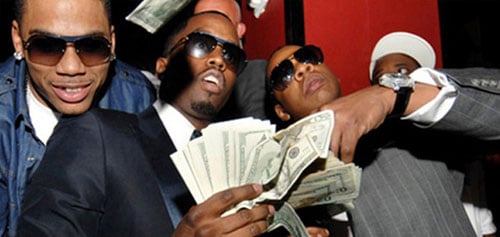 However
much you wanna be the good guy, don't get pulled into buying full
rounds of drinks, especially if you're out in large group. You don't
have a party budget like P Diddy, and if you do, what you doing reading
this guide?
However
much you wanna be the good guy, don't get pulled into buying full
rounds of drinks, especially if you're out in large group. You don't
have a party budget like P Diddy, and if you do, what you doing reading
this guide?
Treating your mates to a round might seem like a nice thing to do, but it rarely works out fairly and often forces you into buying booze when you don't even want any more to drink.
If you do get roped into rounds, why not use this opportunity to save cash (and give your liver a break) by getting yourself a soft drink this time round (whatever it is, ask for a slice of lime in it and no one will even know the difference!).Ditch the credit cards
 Ever looked at your bank balance the morning after and had the shock of
your life? Taking your debit or credit card
out with you is never a good idea as it's so easy to lose track of how
much you've spent (as mentioned above, this is where prepaids come in
handy!).
Ever looked at your bank balance the morning after and had the shock of
your life? Taking your debit or credit card
out with you is never a good idea as it's so easy to lose track of how
much you've spent (as mentioned above, this is where prepaids come in
handy!).
Do yourself a favor and leave the credit cards at home, we promise they won't get lonely.Use free ATMs
 Taking out a cash budget with you for the evening can also be a good
trick to keeping an eye on your spending.
Taking out a cash budget with you for the evening can also be a good
trick to keeping an eye on your spending.
However, whatever you do DON'T use club ATMs. These machines are normally rented out by money-grabbers and will charge an average of 65naira just to withdraw your own money.
Make sure you think ahead and take cash out at a free ATM before you start your night!Party off-peak
 Contrary to whatever Ms Black tells you, Friday isn't the only day you can get down to boogie.
The beauty of student nightlife is that the best parties are normally happening mid-week, and everything tends to be cheaper on week nights rather than weekends.
There's normally a fair few drink promos going on during off-peak party nights too – bonus!Look out for offers
 It
may look a bit excessive, but a cocktail pitcher will often work out
cheaper than individual drinks.
It
may look a bit excessive, but a cocktail pitcher will often work out
cheaper than individual drinks.
Also, rather than buying bottled beer, get the beer on tap as it's so much cheaper.
Loads of bars also do drinks promotions, so it's worth keeping an eye out for those in the drinks section of our student deals page.Alternate with water
 For
every alcoholic drink you have, get a glass of tap water too. It'll
give your liver a break and there is less chance you'll wake up with a
cracking headache.
For
every alcoholic drink you have, get a glass of tap water too. It'll
give your liver a break and there is less chance you'll wake up with a
cracking headache.
Oh, and let's not forget the best part, tap water is F.R.E.E!
Basically, the idea behind this one is that the water will quench your thirst and fill you up quicker – meaning no more room for alcohol.Stay at home
 If
you don't have the Naira, just don't go out – simple as that!
Essentially the point is to have fun with your friends, and you don't
need to be up in da club to do that.
If
you don't have the Naira, just don't go out – simple as that!
Essentially the point is to have fun with your friends, and you don't
need to be up in da club to do that.
Why not have a movie night instead? Grab some popcorn, snuggle under the duvet with your housemates and do some good old-fashioned sober bonding.
you can find out more of these tips from www.savethestudent.org
A Sagacious Survival at the University
University of Nigeria Nsukka
skills to help you survive university
Over time, you’ll realize that having a particular set of skills will make your uni experience a whole lot easier. Here are our favorites to get you started!They say your uni years are the easiest you’ll ever have in your life, but we'd argue that being a poor, knackered, perpetually hungover student does come with it’s challenges, too!
Like, how do you stay healthy when living on a diet of pot noodles? How do you juggle a part-time job to support yourself when you’ve got deadlines left, right and centre? And how does one face the challenge of partying most nights of the week when they can barely afford to feed themselves?
Here are some list of skills:
Budgeting
Let’s be realistic here – you’re going to be skint frequently during your university years (if not consistently). However, being permanently penniless is something you can avoid if you take the time to work out a budget, and stick to it. Luckily, we’ve got a great guide to help you get your budget sorted. A nice option is to get yourself a prepaid budgeting card like this one from Loot, which is specifically aimed at students. Put a certain amount of cash on the card every month and assign this as your disposable income (for food, nights out and other expenses) so this stays separate from your cash for rent and bills. This way, you're much more likely to stay within the budget you’ve assigned yourself (because you have no choice, essentially) and can keep tabs of what you’ve spent by using the app on your phone that's attached to your card (and how much you have left over at the end of the month to reward yourself with for staying within budget!).
If you're looking for a bit more budgeting help, download our free ebook to get swatted up on how to stay in control of your pennies. You can always check out our save money guides for additional advice too.
Knowing when to call it a night
It's easy to get carried away on nights out. ‘Just a few drinks down the union’ can quickly escalate to something out of The Hangover trilogy (we’ve all been there, and paid the price!).
Knowing when to say enough is enough is actually quite a tough skill to acquire, and takes some good and solid will power. One way of attempting to control yourself is to only take out as much money as you’re happy to spend, and when that runs dry, hit the road.
Try not to give in to peer pressure and stay out longer than you intended – you really aren’t going to miss much by going home at 1am, no matter how much it might seem so!
While we’re on the topic, we’ve got a whole guide devoted to mastering the art of nights out on a budget for your consultation.
Meal planning
Having at least a smidge of routine regarding what you eat and when will prevent you from demolishing a week’s shopping in a day or two and save you a fair wad of cash. A great tip is to get into the habit of planning your meals – doing a shop once a week with a few dishes in mind (including one meal that can be divvied up into portions to feed you throughout the week). Don’t forget to factor in a few snackables too though, and some emergency hangover supplies!
One thing to ensure is that you never go shopping when you’re hungry. You’ll end up buying things you don’t need 'cause temptations are so much higher when your tummy is rumbling along the aisles, meaning you’ll end up spending a lot more than you can afford. We’d also recommend trying the supermarket downshift – don’t waste money on overpriced food, and don’t fooled by any of the supermarket’s sneaky tricks they use to get you to spend more.
Make sure you check out our guide to saving money at the supermarket as well as sneak.Avoiding tricky seminar questions
So you haven’t done the reading, but couldn’t afford to miss another seminar? This situation calls for some serious blagging and deflection tactics!
First rule: don’t make eye contact. Pretend to be completely engrossed in your notes, perhaps even adding to them as you become more involved in the riveting discussion going on around you (even if you’re writing complete nonsense and haven't a clue what's going on).
Get actively involved in group work, listen out to what others are saying and try to form something to say out of what's being discussed in these small groups (although, do NOT just copy what someone else in the group has contributed unless you fancy making enemies in class!).
Then, when the class floor is open to discussion, try to speak out as early as possible to get it out of the way. If you keep quiet too long, you might get nailed with a tough question near the end of class, so the trick is to get in there first!
If you’re put on the spot and have no clue, we're afraid the only option left is to get your blag on. And next time – save yourself the hassle and just do the reading?
Bladder control
We all know what it's like to have to hold it in throughout the duration of the most boring class known to man, but you just can't bear the thought of running to the loo in front of a packed out lecture hall.
While we wish we could tell you there's a magical solution for this, there isn't really. You've either got to (wo)man up and take the bladder pain (it all comes down to mind over bladder), or try to wee when you have the opportunity.
Try fitting pee breaks in before every class and lecture – even if that means leaving the house 5 minutes earlier in the morning to make sure you arrive with enough time.
It's important you stay hydrated throughout the day, but don't overdo it either.
Speed reading
If you have the balls to show up to your class without having done the reading, a quick 'speed read' can help bring you up to date with what's going on (not to mention the help for revision).
We wouldn't suggest speed reading an entire novel (*cough* Wikipedia *cough*) but for articles and short chapters, it's certainly better than doing no reading at all.
Use a highlighter to bring out any important sections or quotes (or at least what you think seem important in the 10 minutes you've spent swatting up on the topic). This means when you're in your seminar or exam, it won't look like you haven't done absolutely nothing.
If at any point you get put on the spot, you can divert discussion towards one of the 'interesting' passages you highlighted when you read the article 'thoroughly' the night before.
Asking for help
This goes for all areas of your life – if you're struggling to keep up with coursework (hence all the speed reading and blagging your way through tutorials!), speak to your tutors. If you don't speak up about this stuff, the situation will only get worse as more deadlines pile up.
Likewise, if you're having financial stress (our student money survey this year indicates that 80% of you struggle to make ends meet at uni) it's really important you reach out and get some help.
Asking for some financial support from your rents can be a tough situation for some, but it's also worth remembering that the government calculates how much maintenance loan to give you based on your parents' income.
Therefore, if you're in the lower student loan bracket because your parents have a decent income, it's expected that they will help supplement your loan. Read more on how to have that money discussion with your folks right here.
Where getting some advice is concerned – we're your guys! Take a look at the various money-saving guides we have online, download our free ebook, and even drop us a line directly if you'd prefer and we'll try to help where we can.
Cooking basics
It's not that difficult to eat properly at university. You just have to spend a short amount of time working out the basics and mastering a few really simple meals and you'll be able to feed yourself and save a whole loada cash in the process.
Throwing some pasta and pesto together can make a meal that tides you over for dinner and lunch the next day – you don't have to rely on microwave meals (because they usually taste like crap), or takeaways (because they're expensive, although we have a few tips to get them cheaper now and again!).
We've got a whole load of student budget-friendly recipes for you to try out, as well as a list of cupboard essentials to get you going.
Knowing your limits
We all know booze is just a part of student life, but being the drunkest person in the room is never gonna do you any favours.
Knowing what your limits are when it comes to alcohol will make your life at uni a million times easier – easier on your wallet, your social life, on your ability to keep up with course work and to actually make it to occasionally.
Stick to one type of alcohol throughout the night if you can: If you're knocking back the vodka and mixers, don't decide to switch it up with several shots of whatever, before moving onto beer. It won't do you any good, and your head won't thank you for it in the morning (again, these hangover cures might come in handy too).
Don't carry on drinking if you've had enough just because you don't want to look boring. We can assure you that feeling like you're going to be sick and your brain is about to vacate your skull is a lot more boring than dancing without a vodbull in your hand.
Dealing with chores
You have to clean your own mess now – isn't life unfair! Unfortunately, cleaning has to be done from time to time, otherwise your house will end up completely rank and you'll be ashamed to ever let anyone through the front door.
We would suggest using a cleaning rota so everyone mucks in, but they sometimes don't work if you have any particularly lazy housemates and they can cause arguments. So, our advice would be to clean together.
Put some music on, have a laugh and promise each other a little pizza party once the mess is cleaned up (make sure you eat out the box to minimise more mess, mind). This method is way more fun and gets done in half the time.
And if you're worried about having to be the one to splash out on expensive cleaning products, check out this guide to alternative cleaning products and methods that will cost you next to nothing.
… and difficult housemates
Unfortunately, it's not always hunky dory. If you find yourself living with someone who's making things tricky, talk it out with them. Not addressing the situation will never result in it 'sorting itself out', and result in a nasty passive aggressive atmosphere.
Understandably, it can be harder to deal with problematic housemates if they also double up as your friends. You don't want to nag them or jeopardise your friendship, but not addressing the issue could just as likely lead to this.
If things get really out of hand or you feel you can't deal with it yourself, talk to your landlord. You don't deserve to be unhappy in your own home.
Holding your own
When it comes to things like dealing with landlords and paying bills, the sad fact is a lot of people will see what they can get away with if they think you're an unsuspecting student.
Don't let people walk all over you though – it's painful, demoralising and you've got enough washing to do without all the extra footprints. Do your research so you know your rights and try your best to come across confident, even if you're squirming inside. Remember, you're no mug!
For a few wise words of guidance on how to hold your own at uni, make sure you know your rights as a tenant, learn how to haggle on your bills and check out our guide on how and when to complain.
There you have it! A concise list of skills that will most definitely (hopefully) improve your university life.
If you think any important was missed, give a shout in the comments below!
Thursday, 1 June 2017
TIME TABLE FOR GSP 105 MOP-UP QUIZ (FIRST SEMESTER, 2016/2017)
TIME TABLE FOR GSP 105 MOP-UP QUIZ (FIRST SEMESTER, 2016/2017)
DATE: THURSDAY 1ST AND FRIDAY 2ND JUNE, 2017
DATE: THURSDAY 1ST AND FRIDAY 2ND JUNE, 2017
| S/N | LECTURER | DEPARTMENTS ALLOTED | TIME ALLOTTED |
| Thursday, 1st June, 2017 | |||
| 1 | Prof. Ezema, F.I. | Adult Education | 8:00 am – 8:10 am |
| 2 | Prof. Asogwa, P.U. | Fine and Applied Arts and Archaeology & Tourism | 9:00 am – 9:10 am |
| 3 | Mr. Asogwa, M.O. | VTE (Business Educ.) Foreign Languages & Literature | 10:00 am -10:10 am |
| 4 | Dr. Nwamarah, J.U. | Sociology & Anthropology | 11:00 am – 11:10 am |
| 5 | Dr. Onwubiko, G.N. | Social Work and Linguistics | 12:00 noon – 12:10 pm |
| 6 | Mrs. Awachie, M.N. | Political Science | 1:00 pm – 1:10 pm |
| 7 | Dr. Otitoju, G.T.O. | Combined Arts and HPE | 2:00 pm – 2:10 pm |
| 8 | Dr. Ezekoye, V.A. | Arts Education, Theatre & Film Studies and Geography | 3:00 pm – 3:10 pm |
| 9 | Dr. Atugwu, A.I. | Psychology and Library and Information Studies | 4:00 pm – 4:10 pm |
| 10 | Dr. Agwu, E. J. | Economics and Music | 5: 00 pm – 5: 10 pm |
| Friday, 2nd June, 2017 | |||
| 11 | Dr. Ibeanu, F.N. | PALG | 8:00 am – 8:10 am |
| 12 | Mrs. Isuosuo, C.C. | Social Science Education
Mass Communication Educational Foundations |
9:00 am – 9:10 am |
| 13 | Mr. Ugwu, K.O. | Law | 10:00 am -10:10 am |
| 14 | Mrs. Nzei, J.I. | Management Urban & Regional Planning | 11:00 am – 11:10 am |
| 15 | Dr. Asuzu, C.U. | History & Int’l Studies English & Literary Studies | 12:00 noon – 12:10 pm |
| 16 | Mrs. Nwanya, A.C. | Combined Social Sciences | 1:00 pm – 1:10 pm |
| 17 | Mrs. Nweze, B.C. | Accountancy | 2:00 pm – 2:10 pm |
| 18 | Mrs. Okoroigwe, F.C. | Banking & Finance Estate Management | 3:00 pm – 3:10 pm |
| 19 | Mr. Ugwoke, R.O. | Marketing | 4:00 pm – 4:10 pm |
| 20 | Dr. Ugwu, E.B.I. | Philosophy Religion and Cultural Studies | 5: 00 pm – 5: 10 pm |
GSP 201 Mop up Timetable
Due to issues on the GSP test of 1st semester, their has been released another time table for everyone offering the GSP courses.
GSP 201 QUIZ TIME TABLE FOR FIRST SEMESTER OF 2016/2017
DATE: June 3-6, 2017
VENUE: ANYWHERE
GSP 201 QUIZ TIME TABLE FOR FIRST SEMESTER OF 2016/2017
DATE: June 3-6, 2017
VENUE: ANYWHERE
| S/N | LECTURER | DEPARTMENTS ALLOTED | TIME ALLOTTED |
| 3rd June | |||
| 1 | Dr A.O.J. Iheanacho | Electronic Engr., Sci. Edu. & Lib./Info Sci. | 8:00 am – 8: 10am |
| 2 | Dr E.C. Ngwu | Med.& Surg, FAA & Soc Work | 9:00 am – 9:10 am |
| 3 | Dr C.C. Ugwu | Econs, Botany & Maths | 10: am – 10:10 am |
| 4 | Dr. J.E. Eze | Soc. Sci. Edu, Nursing Sci. & Geography | 11:00 am – 11:10 am |
| 5 | Dr. C.N. Ibenwa | Electrical Engr., Stats & Medical Rehab | 12:00 Noon – 12:10 pm |
| 6 | Mrs O.I Anthony Orji | Mass Comm. , VTE & Dentistry | 1:00 pm – 1:10 am |
| 7 | Mr C.Q. Chukwu | Arts Edu., Civil Engr. & Arch/Tourism | 2:00 pm – 2:10 pm |
| 8 | Dr Mrs F.N. Onah | Zoology, FST & Agric. Econs | 3:00 pm – 3:10 pm |
| 9 | Dr. K. Udegbunam | PALG, TFS, Soil Sci. & HPE | 4:00 pm – 4:10 pm |
| 10 | Miss C. Kalu | Vet. Med, Agric Ext. , Crop Sci, Animal Sci. & Religion | 5:00 pm – 5:10 pm |
| 11 | Miss O. Igweonu | Eng/Lit Stud. & Socio./Anthro | 6:00 pm – 6:10 pm |
| 5th June | |||
| 12 | Mr D.O Anyadike | Met/Mat. Engr, Pol. Sci. & Physiology | 8:00 am – 8:10 am |
| 13 | Mr. J. Nwofia | Comb. Arts, Psychology & FLL | 9:00 – 9:10 am |
| 14 | Mr. P.E. Ezeme | PIC, Hist / Intern. St, Music, Anatomy & Philosophy | 10:00 am – 10:10 am |
| 15 | Mr V.C Nwokocha | Mech. Engr., & Linguistics | 11:00 am – 11:10 am |
| 16 | Mr P.O Okonta | Microbiology | 12:00 -12:10 pm |
| 17 | Mr C.E Nwankwo | CBS, Edu Foundation &Geology | 1:00 pm-1:10 pm |
| 18 | Mr C.C. Mbaegbu | Comp Sci, Med. Radio & HSND | 2:00 pm-2:10 pm |
| 19 | M.D. Udoudom | Comb. Soc. Sci. & ABE | 3:00 pm – 3:10 pm |
| 21 | Mrs C.F. Abada | Med. Lab. Sci. & Physics/Astro | 4: 00 pm – 4:10 pm |
| 22 | Dr .D.C. Ononogbu | Pharmacy & Adult Edu | 5: 00 pm – 5:10 pm |
| 23 | Mrs H. C. Nnadi | Biochem. & Comb. Physical Sci | 6:00 pm – 6:10 pm |
| 6th June | |||
| ENUGU CAMPUS | |||
| 24 | Dr. C.N. Ayogu | Banking and Finance, Marketing and Nursing | 8:00 am – 8:10 am |
| 25 | Mr K. Ilo | URP, Survey & Geo., Estate Management, Med Rehab, Med Radio, Med Surg, and Dentistry | 9:00 am – 9:10 am |
| 26 | Dr. C. Obasi | Accountancy and Management | 10:00 am – 10:10 am |
| 27 | Mrs R.G. Nnamani | Law and Medical Lab Science (Enugu Campus) | 11:00 am – 11:10 am |
Wednesday, 31 May 2017
A Nation in crisis: An appeal for morality
University of Nigeria Nsukka
Professor Paulus Zulu’s 2013 book is authoritative. It stands as a compelling indictment of the lack of public morality in the governance of South Africa by governing bodies, parliament and the ruling political party – the African National Congress (ANC). The book undertakes a critical discussion of morality in South Africa, tracing its roots and its manifestation in the public sphere. The book is heavily laden with academic jargon but is not overbearing and remains palatable to the general reader who is not a student of morality as an academic discipline and its informing philosophies.Zulu’s model of analysis is borrowed from the works of Joseph Schumpeter who coined the ‘thesis of political entrepreneurship’ and is complemented by the concept of ‘political instrumentalisation of disorder’ as asserted by Chabal and Daloz. However, there may be other conceptual sources and one should not downplay the influence of a concept borrowed from an essay written in 2008 by South African struggle poet, Breyten Breytenbach. He had coined the phrase ‘public office as an exercise in scavenging’. Supplementary to these three analytical frameworks is the perspective taken from political science that ‘one party dominance’ in a democratic state brings into question the very bona fides of that country’s democracy.
Broadly speaking, it is tempting to locate the book within those that analyse the patrimonial state. However, this is for the reader to infer as the book is subject to interpretation. I choose to view the book as an explorative indictment of the lack of public morality in those that govern, and to regard its setting largely as that of the interplay between the state and the ruling party. Zulu explores a vast number of examples: from the Travelgate scandal to the challenges facing the judiciary through the case between Judge John Hlope and Justices of the Constitutional Court. A number of public protests are cited, to indicate that citizens are revolting because of a dream deferred – the dream that was promised to them in 1955 through the declaration of the Freedom Charter and 39 years later in 1994 through the ushering in of democracy.
The book has seven chapters that deal (respectively) with the roots of public morality in South Africa, the question of a dream deferred, parliamentary oversight, democracy under siege, the widening wealth gap, the question on whether a universal standard for right or wrong exists and, lastly, issues of owning up and taking responsibility for one’s actions. Zulu offers this explorative indictment knowing fully well that not everyone will agree with his interpretation of events and certain actions; let alone his book. This Zulu attributes to the concept of ‘contested registers’, wherein there is no agreement on what is right or wrong and how the wrong should be rectified or maintained – thus leading to contested concepts of justice.
To illuminate this point, he gives an interesting account on how the discourse on Black Economic Empowerment (BEE) as a tool for redressing the past injustices suffered by black people under colonialism and apartheid is contested. However, Zulu is not interested in the concept or rationale of BEE per se (not to say this does not matter; it simply does not fit into his adopted analytical framework). He is occupied with looking at the conduct and practice of politicians and senior bureaucrats in implementing BEE. Here he details many cases that bring to fore the ubiquity of corruption in the dealings of those who govern.
Zulu finds contesting registers even within the ruling party itself, citing the desire by the Minister of Cooperative Governance and Traditional Affairs to ban the holding of top municipality positions by political office bearers. The 2010 National General Council of the ANC called for a revision of the Bill that the Minister had submitted in Parliament to effect this desire to separate the party from the state. Herein we can note that the party was deliberately attempting to maintain its influence on the running of municipalities.
Zulu emphatically states that ‘public morality in governance is approaching a state of moral abyss’ (p. 160). For this to be turned around, he does make a number of proposals. These include electoral system reform, the election of men and women of integrity into political office and the improvement of governance systems. In the latter proposal, the author considers the idea of doing away with the second sphere of government – provinces. This is an idea hardly discussed, however. The discussion is mainly about re-demarcating provinces and about increasing or decreasing their number.
However, thinking of doing away entirely with provinces could revolutionise how we think about district municipalities and about devolving more powers to them. Ultimately, this could lead to the decentralisation of governance to bring it closer to people, create better space for accountability and transparency, and increase professionalisation by redeploying some provincial public servants at municipal level. I am simply expanding and thinking on this idea by Zulu. In the book he does not elaborate much on it.
Whilst the book traces and exposes the presence of malfeasance in the governing of present day South Africa, there is little tracing done of its roots and foundations within the apartheid government days. This would expand our understanding of whether the entire genesis of corruption is attributable to the ruling party or whether certain aspects of it were systematically embedded in the structure of governance that the ANC inherited from apartheid. Of course, Zulu does not disagree that corruption existed under apartheid. At issue here is the lack of exposition on this aspect and how corruption has sustained itself in the era of democratic dispensation.
The BEE deals that are cited by Zulu as vehicles of this malfeasance are themselves owned and managed by people who either founded them or inherited them from apartheid era participants. These owners do not guard against the corruption, and in many cases wilfully assist to ensure these BEE deals benefit politicians, state officials or their friends and families. It will be important in future for a study to be conducted towards understanding this collusion in the making of corruption between the current ruling elite and the former ruling elite under apartheid. More so, because Zulu himself emphasises that South Africa is dealing with politics of transition and ethical dilemmas attendant to such a phase of development.
The final chapter is one of the most important in the book. Here, Zulu deals with how politicians and senior public officials react when they are confronted with wrongdoing. Finding a glimpse of hope in the actions of the Gauteng Provincial Minister of Health, Qedani Mahlangu, who apologised to affected mothers due to shortage of a baby formula in a public hospital, Zulu calls this a rare occurrence in South Africa. When a politician practises such a form of taking responsibility, he/she can be said to be within the ‘confessional modality’. Here, the politician or senior official in the wrong exercises contrition (realising his/her wrongful act), then confesses to it and ultimately experiences atonement. Other forms of reaction include legalism, wherein the accused person responds with ‘I will meet you in court’, certainly a growing phenomenon these days with ever increasing numbers of court cases now involving Ministers and/or senior public servants across the government and in parliament.
The third response is moral relativism, wherein the accused points a finger at the pervasiveness of what they are being accused of, claiming that ‘others are also doing it’. The fourth response is restitutive morality, wherein the accused invoke historic successes and heroism to obfuscate the current accusation against them. This would fit in well with a perspective by Franz Fanon in his seminal Pitfalls of National Consciousness wherein he warned that liberation movements will tend to invoke struggle credentials to remain relevant in the face of people’s despondency. The last response is conferred innocence, wherein the accused retorts by the Animal Farm dictum that some pigs are more equal than others.
Zulu’s book can be summed up as a contribution to meet the need to build a South African democracy, anchored on sound and solid institutions, and led by men and women who function within the Kantian concept of deontological morality – wherein the actions of governance must in themselves be morally sound and ethical in pursuit of a noble end. Democracy for Zulu is built on three pillars: fraternity, equality and liberty. He counsels the reader soundly that ‘a country’s human rights record is not judged by the GDP per capita that it generates nor by conspicuous consumption, but rather by the absence of beggars in the streets’ (p. 17). Therefore, consolidating the South African democracy is in the interest of building a more just and prosperous society – reversing the malaise that is leading millions of people to the perception of a dream deferred.
Ethnic and Religious Crises in Nigeria
University of Nigeria Nsukka
Nigeria is synonymous with deep divisions which cause major political issues to be vigorously and violently contested along the lines of intricate ethnic, religious and regional divisions. Issues that raise the most dust are those regarded essential for the existence and the validity of the state. Opposing and contending assemblages have a tendency to assume an exclusionary winner-take-all approach. These issues include the control of state power, allocation of resources and citizenship. As a result, states with such divisions are disposed to be delicate and unstable because almost by definition, they have very little in common with regard to convergence and harmony which are necessary to reduce the centrifugal forces that rip them apart (Osaghae and Suberu 2005:4).Therefore, breakdown, breakaway, civil strife, civil war, minority nervousness, and violent clashes, all of which would typically be regarded unusual in normal states are common forces or actual occurrences in divided states (Osaghae and Suberu 2005:4). Because of a complicated network of politically silent identities, coupled with a history of protracted and seemingly stubborn wars and instability, Nigeria is high on the list as one of the most unstable states in Africa. Since its independence, Nigeria has been driven hither and thither by recurrent crises of regional or state illegitimacy, often impairing efforts at democratisation, stability, economic transformation and national cohesion. A peak of the crisis appears to have occurred during the civil war of the 1960s, which began shortly after independence (Okpanachi 2010). Since 1999 when Nigeria transited into civilian rule, the country has witnessed a rapid increase in the number of conflicts. The aim of this study is to examine the relationship between religion, ethnicity and those conflicts in the country. It looks at the notion of Identity in an attempt to explain the crisis of development and the complexities of modern Nigeria.
A high level of corruption and the looting of state resources is another serious and ‘pandemic’ (Dike 2005) problem that makes all forms of conflict and trouble worse in Nigeria. The country is ‘richly endowed with natural resources and high quality human capital’ (Ogbeidi 2012:1), but corruption is one of the main reasons that affect the development of the country in a negative way. The appropriation of state resources by certain hands makes poverty and bitter anger inevitable aspects of daily socio-economic and political routine. In this sense, though corruption is not peculiar to Nigeria, many sources call it the ‘bane of the country’ (Dike 2005; Ogbeidi 2012:21). And of course, corruption is considered to be one of the main causes of ethno-religious conflicts (Nwankwo 2015). Poverty and injustice caused by corruption weaken any sense of mutual tolerance, social solidarity or coexistence, while reawakening social hatred, radicalism and violence. For this reason, corruption is seen as one of the most important issues that has to be resolved in order to cope with ethno-religious conflicts in Nigeria.
The identity factor
From a socio-political perspective, ‘identity’ bears a personal and a social meaning. Processes related to identity are ‘located at the core of the individual and yet in the core of his community culture’ (Erikson 1968:57; Okpanachi 2010). Thus, identity can be said to be an individual’s ‘sense of belonging to a group if (it) influences his political behavior’ (Erikson 1968:57; Mary Anderson 2010; Okpanachi 2010). Identity is built into an individual’s physiological ‘givens’ and in social roles (Erikson 1968:57; Okpanachi 2010). Identity is characterised by features such as an ‘emotive tie to a group’, ‘love and belief for a group’, ‘pledge to a cause’, and ‘commitments and duties to a group’ with which a person identifies (Smyth and Robinson 2001:7-11; Okpanachi 2010).General studies in identity underscore the fact that identity implies similarity and contrast at the same time (Jenkins 2004; Okpanachi 2010). ‘For an individual, or for a group, there may be a plurality of identities. Yet, such a plurality is a source of stress and contradiction in both self-representation and social action. This is because identity must be distinguished from role-sets’ (Okpanachi 2010).
According to Castells, notions of identity are present only when social actors co-opt them (Okpanachi 2010; Castells 2010:8). Oftentimes, self-definition of identity overlaps with role expectations, but identities are more stable springs of meaning than those social roles. This is because identities establish the meaning, while social roles shape the functions (Okpanachi 2010; Castells 2010:7). However, identity is not uniform or stable among groups or individuals. Its strength and importance is dynamic and differs from group to group. While identities are somewhat stable, identity consciousness keeps on changing to reflect the fluctuating role of the identities and the swelling magnitudes (Jega 2000:11; Okpanachi 2010). This elasticity of identity avoids coming up with an all new identity for the particular role and circumstance. Social forces, then, strongly affect identity building and formation (Okpanachi 2010).
Recent studies on religious identity have also underscored the positive function of religion in promotion of peace. On the other hand, however, mobilisation of identity has been used to incite political groups to struggle and religious groups to legitimise wars and various modes of brutal and violent acts (Alger 2002:101; Okpanachi 2010).
Politics of ethnic identity in Nigeria
Ethnicity is a social phenomenon that is manifested in interactions among individuals of different ethnic groups within a political system where language and culture are the most prominent attributes. The formation of dialects within languages was one of the ways in which ethnicity – both small-scale and large-scale – became fixed in Nigeria. Although there are over 400 languages in Nigeria, only three are considered important while the rest are considered minor languages. However, the distribution of these languages is directly proportional to both political and socio-economic power, and therefore the language group to which one belongs defines his/her status in the society. Missionaries and local politicians created standard languages and hoped that they would homogenise language and ethnicity, and create more harmonious ethnic identities.Ethnicity is natural in almost all societies made up of more than one ethnic group. This observation tends to offer the suggestion that the interaction between different ethnic groups within a single political set-up generates ethnic identity. An interaction of this kind can create ‘a common consciousness of being one in relation to other relevant ethnic groups’ (Eriksen 1996:30). That in turn, results in the emergence of in-group and out-group confines which come to be guarded jealously over time. Based on this approach, ethnicity thus becomes a process through which ethnic identities are politicised (Eriksen 1996:30).
Historically, identities have played a significant role in the Nigerian political process during the colonial period and in the post-colonial era. During the colonial period, the administrators allowed the emergence and aggravation of an ‘us’ versus ‘them’ syndrome, where Muslims were pitted against Christians, Northerners against the Southerners, Hausa-Fulani, Yoruba and Igbo against each other, and so on (Adefemi 2003:14; Okpanachi 2010). In this era religious and ethnic differences became prominent factors in instituting and executing socio-economic strategies and applications. Therefore, the differentiating outcomes of colonialism became the forerunner of the socio-economic disequilibrium among the different regions, and then this became an important factor in the stimulation of identity awareness so as to efficiently ‘divide and rule’ (Fearon and Laitin 2003:82; Okpanachi 2010). But, as a counter argument it must be said that internal factors are more determinant than the external ones in creating the cleavages in Nigeria. This is also the case in many other countries.
Ethnicity is seen as the most basic and politically salient identity of Nigerians. This argument is based on the premise that in their competitive and non-competitive contexts, Nigerians tend to define themselves in terms of ethnic affinities as opposed to other identities (Osaghae and Suberu 2005:8). A survey conducted in Nigeria by Lewis and Bratton found that almost half of Nigerians (48.2%) labelled themselves with an ethnic identity compared to 28.4% who labelled themselves with respect to class and 21% who identified with a religious group (Lewis and Bratton 2000:27; Osaghae and Suberu 2005:9). This means that over 66% of Nigerians view themselves as members of an elemental ethnic or religious group. What is even more interesting is the fact that religious and ethnic identities are more salient than class identities (Lewis and Bratton 2000:26; Osaghae and Suberu 2005:9). However, this is not at all that surprising, especially if one considers that ethno-religious formations are the most persistent behavioural units in Nigeria (Nsongola-Ntalaja 2004:404; Osaghae and Suberu 2005:9).
Nevertheless, notwithstanding the fact that ethnicity is the most salient, and the large number of studies conducted on this issue, the total number of ethnic groupings in Nigeria remains unknown (Osaghae and Suberu 2005:9). Some sources put it at 374 (Otite 1990:34; Okpanachi 2010), while some other sources count more than 250 different ethnic identities (Central Intelligence Agency 2016). However, the population percentages of the majority of these groups are small when compared with the seven largest ethnic groups constituting about 88% of the country’s population. These are Hausa and Fulani (29%), Yoruba (21%), Igbo (18%), Ijaw (10%), Kanuri (4%), Ibibio (3,5%), and Tiv (2,5%) (Central Intelligence Agency 2016). This population disproportion when combined with the disparities in the political influence of individual ethnic groups roughly classifies the Nigerian population into two major groupings: the majority and minority ethnic groups. When the Hausa-Fulani, the Yoruba and the Igbo form the majority, the rest of the ethnic groups are fitted into the minority classification which in itself possesses different degrees of status relative to their size and political influence (Rakov 1990; Paden 2008:4; Okpanachi 2010).
The Hausa-Fulani and other smaller ethnic groups that inhabit the north of the country are Muslims while the Igbo and the other smaller groups residing in the South are primarily Christians. Groups lying in the middle comprise a mixture of Christians and Muslims while the Yoruba found in the Southwest are almost half Muslim and half Christian. This Muslim North and Christian South cleavage enhances ethnic fractionalisations in Nigeria, especially in Northern Nigeria where Islamic identity plays a dominant role (Paden 2007:8; Okpanachi 2010). It is clear that nearly the entire Northern half of the country consists of states with Sharia law.
Of course, exceptions should not be overlooked for both parts of the country. There is a considerable population of Muslims in the South, especially in the Southwest, and a sizeable number amongst the Benin in Edo State. Even in the Southeast, amongst the Igbo, there has been a rising number of Muslims, causing the governors of some Igbo-speaking states to introduce state programmes for Muslims. The same goes for Christians in the North, where the considerable number of Christians cannot be disregarded in any analysis of religious groupings in Nigeria.
Lewis (2007:6) attributes the historical prominence of Islam during the formation of Northern states in the early 19th century to the continued prominence of Emirs and religious authorities in framing identities in Northern Nigeria. Lewis argues that a number of principles of ethnicity are used by political leaders and others to frame their arguments as to how things should be accomplished. First, ethnic identity is the most important and consistent basis of social identity in the country. Second, ethnicity is seen as a way for collective action. Finally, ethnicity is presumed to be a destabilising factor with far-reaching impacts on democracy. These principles breed a number of outcomes. Because political competition is played along lines of ethnicity, the resultant ‘democratic’ but authoritarian government ostensibly has an ethnic character (Lewis 2007:2).
Lewis states that civilian governments supposedly promote the creation of an ethnic politicisation and political schism. On the other hand, non-democratic regimes like military rules are usually repercussions from the side of the political elite. In most cases, therefore, mechanisms of political governance are formed on the basis of ethnicity via custom-made patronage systems (Lewis 2007:2). For instance, in Nigeria the ethnic factor is seen when political parties are formed and during elections. The Northern People’s Congress (NPC) was formed in the first Republic and it was a Hausa-Fulani party. Similarly, the Igbos belonged to the National Council of Nigeria and Cameroon (NCNC) while the Yoruba prided themselves as members of the Action Group (AG) (Cohen 1968). These parties later transformed into The National Party of Nigeria (NPN), the Nigerian People Party (NPP) and the Unity Party of Nigeria (UPN) during the second republic (Edoh 2001:87). The third Republic, attributed to the Social Democratic Party (SDP) and National Republican Convention (NRC), was disbanded by annulment of the June 12, 1993 elections due to ethnic reasoning when it became clear that the Northern political hegemony risked being lost forever. Thus, here it is possible to detect that stimulation of ethnic awareness easily turns into a conflict in order to get more from scarce societal resources. And this situation provokes political tensions and cleavages among the ethnic groups. Nigeria is not the only country in the world where such things are experienced.
In recent times, socio-economic and political changes have taken place and transformed the delineations of identities and politics in Nigeria. To begin with, patterns of group mobilisations have shifted. In the traditional models of Nigerian ethnic politics, emphasis was on competition among the country’s three largest groups – the Hausa-Fulani, the Yoruba and the Igbo. The minority groups comprising over 250 smaller ethnic groups have often been regarded as inconsequential in political contests. However, since 1999, Nigeria’s political arena has been changing following political action by groups in the Niger Delta and the ‘middle-belt’ communities who have increasingly become vocal in national politics and economy (Soludo 2007). Ethnic solidarity has also faced opposition from religious mobilisations by the Muslims and the Christians especially in the Muslim North.
Since the restoration of democratic rule, ethnic identity and mobilisation in the Nigerian political landscape has often resulted in political instability. Between 1999 and 2013, more than 11 000 deaths have occurred as a result of more than five hundred incidents of communal violence. Ethnic violence has been witnessed in almost all regions in the country but with particular frequency in the Niger Delta, the Muslim North and Northwest, and along the middle-belt (Uzodike and Whetho 2011:220). The level of insecurity witnessed during the post-military period is considerably higher than that experienced during the three decades of military rule that ended in 1999. It is often assumed that there exist stable identities in Nigeria and consistent group motives in the approach to ethnic politics (Rotberg 2002:88). However, the upsurge of ethnicity in Nigeria in recent years leads researchers to re-examine identity formation.
Religious identity
Nigeria is the most crowded African country with a population of about 182 million by 2015 (World Population Prospects 2015:21). A majority of the scientific academic sources accept that the half of the population is Christian, the other half Muslim. However, there is uncertainty about the exact percentages, hence various sources give different figures. In a report published by Pew Research Center in 2010 the numbers from different sources are compared in the report’s Appendix B. If we mention them chronologically for instance, the 1963 Census certified 36% Christian, 48% Muslim and 16% other. However, the Demographic and Health Survey gave 53% Christian, 45% Muslim and 2% other in 2008. Similarly, Afrobarometer found 56% Christian, 43% Muslim and 1% other, also in 2008. And finally, Pew Forum declared 46% for Christians, 52% for Muslims and 1% for others in 2009 (Pew Research Center 2010). Whatever the exact percentages are, it is clear that Nigeria is a country with very large Christian and Muslim populations. This situation makes this country a potential fault line between the two different identities and even civilisations. In this sense, Nigeria, with the largest Christian plus Muslim population in the world, can be defined as a ‘cleft country’ and then a ‘test case’ of Huntington’s Clash of Civilisations thesis (Paden 2007; Olojo 2014:7).Although the general presumption is that ethnic identity is a more prominent and stable source of identity in Nigeria, some researchers have demonstrated that religion was more significant than ethnicity as a source of identity and conflict in Nigeria (Ruby and Shah 2007; Pew Research Center 2010; Green 2011). In fact, in the Hausa-Fulani North, religious identity is more pronounced than ethnic identity and only serves to stimulate ethnicity (Osaghae and Suberu 2005:10). Therefore, of the two major ethnic groupings in the country, the Yoruba are more likely to identify themselves with their ethnic group than are the Northern Hausa-Fulani (Lewis and Bratton 2000:20; Osaghae and Suberu 2005:11).
Nigeria has three major religious identities: Christian, Islam and traditional religions (Omorogbe and Omohan 2005:557; Osaghae and Suberu 2005:11). Traditional religions are the most politically inactive of the three groups, ‘numbering several hundreds of ethnic groups and sub-groups, villages, clans and kin groups; and, involving the worship of different gods and goddesses’ (Osaghae and Suberu 2005:11). On the other hand, Christian and Muslim identities have continued to be the backbone of religious disparity and conflict (Lewis and Bratton 2000:5; Osaghae and Suberu 2005:11). This differentiation underlies the North-South cleavage.
It is worth noting that, within the wide Christian and Muslim categories, there lie many sub-cleavages and intra-group conflicts that have either been active politically in the past or have a potential of being salient in the future. Among the Christians, sub-cleavages include the Protestants (Anglican 10%, Baptist 8%, Methodist 5%, and Lutheran 5%), the Catholics 15%, the Evangelical Church of West Africa 2%, Jehovah’s Witnesses 5% and a myriad of other local (Aladura, Cherubim and Seraphim, Celestial Church of Christ 20%) and Pentecostal churches 30% (Osaghae and Suberu 2005:11).
The Pentecostal churches form the fundamental division of Christianity in Nigeria which has experienced rapid growth in numbers of followers in the last few years with the majority of adherents, especially the youths, joining the church from the older and more traditional denominations. The church has played an important role in civil society in anti-military struggles and democratisation. This has been made possible through umbrella bodies such as the Christian Association of Nigeria (CAN), the Pentecostal Fellowship of Nigeria (PFN), and the Catholic Bishops Conference (Osaghae and Suberu 2005:11). However, politicisation of Christianity has been reliant on moves by the Muslims and the interventions of the government. Still, Protestant-Catholic cleavages have continued to play an important role in elections among the Igbo communities living in the Southeast of Nigeria (Osaghae and Suberu 2005:11).
Muslims also belong to a number of sub-cleavages that include Ahmadiyya 12%, Sanusiyya 5%, Tijanniyya 3%, and Quadriyya 8% which have in turn been in conflicts. And as among the Christians, the Muslims also have umbrella bodies which aim at propagating different understandings of Islam. Notable among these organisations is the Jamaatu Nasril Islam (JNI) which was established by Sardauna of Sokoto in 1961. Following events in Iran during the Islamic revolution of 1979, radical fundamentalist activities increased among Muslim youths. These conditions resulted in the formation of fundamentalist Muslim factions such as the Maitatsine, the Isala movement, the Shiites, the Talibans and most recently the Boko Haram (Fayemi 2011) which demanded the establishment of a purist Islam based on Sharia law, the abolition of unorthodox innovations, and the creation of an Islamic theocracy (Osaghae and Suberu 2005:11). These relatively new sentiments that depend on a unique and radical interpretation of Islam provoke conflicts with the traditional and/or more moderate understandings.
Ethno-religious conflicts
The fact that an average Nigerian is very religious was observed by some sources (Oluduro 2010:209; Ekundayo 2013:29). Religion plays a critical role in Nigerian society and has expressed itself as a potent force in the geopolitical development of the country. This force which has been used to unite Nigerians is the same force that has led to numerous conflicts in the country. Nigeria has been engulfed in numerous religious crises and/or conflicts between 1980 and 19941 (Warner 2012:38).Due to their tendency to spread into other areas after an early stage in one area, ethno-religious conflicts have gained notoriety as the most violent crises in Nigeria. Most of these conflicts occur in the middle-belt and along the culturally borderline states of the predominantly Muslim North, and also take place between Hausa-Fulani groups and non-Muslim ethnic groups in the South (Osaghae and Suberu 2005:19). In conflicts of this nature occurring along the convergence of ethnic and religious lines, it is often very difficult to tell the differences between religious and ethnic crises because the dividing line between them is slimmer than thin. Examples of such ethno-religious conflicts are the Kafanchan-Kaduna crisis that occurred in the 1980s and 1990s, the Kaduna Sharia riots of 2000 and the Jos riots of 20012 (Osaghae and Suberu 2005:19). Several hundred lives were lost during the Kaduna crisis of 2000 and the Jos insurrection of 2001. The crises caused violent ripple effects that spread beyond Kaduna and Jos (Enukora 2005:633).
Other recent ethno-religious conflicts include the July 1999 conflict among the Oro cultists in Sagamu in Ogun state who claimed that the Hausa women had come outside when the cultists were outside with their gnome. The result were arguments that finally turned into a full-scale crisis. Many Yoruba and Hausa people were killed before a dusk to dawn curfew was imposed on the Sagamu town. Even as the infamy was being put under check in Sagamu, reprisal attacks continued in Kano, in Hausa city, leading to deaths and destruction of property worth billions of Naira (Kura 2010:33-34).
Another ethno-religious conflict that had far reaching impacts on the people of Nigeria was the October 2000 Lagos-Kano (Idi-Araba/Oko-Oba) conflict which was caused by a misperception between the Hausa inhabitants and the Yoruba living in Lagos over the use of a convenience by a man from Hausa. The mayhem resulted in the death of many Yoruba. As a consequence, the O’dua People Congress (a Yoruba militia) was formed and worsened the situation as the violence later spread southwards to Kano (Enukora 2005:633; Kura 2010:34).
Worse still, in September 2001, ethnic friction between the Tivs and the Iunkuns in the Plateau state reached fever pitch following what came to be referred to as ‘mistaken identity’. ‘What this means is that some Tivs took some nineteen soldiers to be Iunkuns in fake army uniform. The Tiv youths captured them and slaughtered them one by one’ (Kura 2010:34-35). And then the Nigerian army embarked on devastating reprisal attacks in Saki-Biam. According to some controversial numbers at least a hundred people died in the army attacks (Human Rights Watch 2001). Violence spread to Jos plateau especially after a Christian was appointed as a Local Council Chairman. By the time the menace was brought to a standstill, over 160 lives had been lost (Kura 2010:35).
A case of the North: Boko Haram
Between 1999 and 2013, numerous conflicts have been witnessed in Nigeria. The most important among them is the Boko Haram crisis which is on-going. This group has started a bloody campaign to impose a sui-generis Islamic regime based on Sharia in the Muslim North of the country. Actually, it is hard to argue that Boko Haram is a religious or ethnic conflict. In the former case, it targets more Muslims than Christians. In the latter, it is mostly an ethnic Northern conflict. For this reason, though Boko Haram uses a religious discourse, it may be more appropriate to call it simply a terrorist organisation.With regard to the numerous conflicts and the Boko Haram menace in particular, the country’s stability is under constant threat. Boko Haram has introduced into Nigeria’s political and social life a level of insurgency never witnessed before. The insurgency became violent in 2008 even before the country could heal from previous ethno-religious conflicts (Shehu 2011:3).
Boko Haram was founded in 2002 by Muhammad Yusuf. It is formally identified by its members as ‘Jama’at ahlis Sunnah lid Da’wat wal Jihad’, which means ‘people committed to the propagation of the Prophet’s teachings and jihad’. The name of the group ‘Boko Haram’ is loosely translated from the Hausa language to mean ‘western education is sinful’. This meaning is extended to mean any western culture is prohibited. It is for this reason that followers of this outfit advocate for a government based on Sharia as opposed to a democratic one. It is possible to count Wahhabism, Salafism and Islamic fundamentalism as the basic items of the Boko Haram’s ideology. The group which was founded in 2002 in Maiduguri did not become militant until 2009 when its leader was captured and killed by the Nigerian army. Since then, the group has engaged in gun battles, arson, bombing and stabbing, in promoting their ideology (Warner 2012:40). Moreover, Boko Haram has captured a territory in and around Borno state in the Northeast part of Nigeria in 2014. However, the territorial control of the group has been removed by the Nigerian army in 2015.
Boko Haram can be examined in various ways. Firstly, it refers to a long history characteristic of Northern Nigeria and the continued radical Islamic movements. Secondly, the group has its foundations in the socio-economic marginalisation of the country’s northern population. Thirdly, Boko Haram is understood as seeking revenge especially in response to unacceptable behaviour of the law enforcers. The fourth understanding is based on the perception that Boko Haram is utilised by the elites from the North to express their grievances over lack of interest demonstrated by the central government. Finally, the group can be understood as developing as an offshoot of the Al-Qaeda in the Islamic Maghreb (AQIM) and probably Al-Shabaab (Warner 2012:39).
It is important to note that apart from the group targeting national events, markets and churches, they are sometimes engaged in sporadic bombings in major towns in Northern Nigeria including Kaduna, Saria, Jos, Kano, Maiduguri, and in Damaturi. During such instances, the fighters kill indiscriminately – Muslims and Christians alike. Despite everything, the group leaders have often stated that they are still fighting for justice and the Islamisation of Nigeria (Roach 2012:4). The group has declared its allegiance to the Islamic State (IS), as has been done by a series of terrorist groups from various parts of the world. In this context, Boko Haram can be seen as yet another reflection of the religious looking international terror campaigns now sweeping the globe scene.
Inter-religious conflicts
Inter-religious conflicts in Nigeria form part of the dynamics of identity politics. Political elites in Nigeria have always sought to reap advantages from the multidimensional identities, more so during electioneering periods, and this has resulted in conflicts and instability. This politicisation of religious identities during contests for political office often lacks any sustaining unifying ideology. Somehow, politics in Nigeria are fashioned on the appeasement of religious motives. As a consequence, religion attains the level of deification that is difficult to challenge or overpower. In their quest to assume power and state resources, the elites constantly modify patterns of political domination. In this perpetually changing pattern of domination, fears and anxieties are bred that motivate an upsurge in struggle and intolerance (Ibrahim and Kazah-Toure 2003:18; Okpanachi 2010).Since the return of civilian rule in 1999 following a protracted period of military rule, Nigeria has continued to experience recurring ethno-religious conflicts. Although some of these struggles are low-intensity contestations and rancorous wars of words, other have degenerated into bloody sectarian fights. Thousands of Nigerians have been left dead, wounded and homeless over the years due to constant religious strife pitting people of different religions against each other (Okpanachi 2010).
The main forms of inter-religious conflicts in Nigeria are between the Muslims and the Christians. The conflicts are sometimes so intense that they have turned into wars in different parts of the country, and they range from the Kano revolt (1980), Bulunktu Bisarre (1982), Kastina crises (1999), Samfara conflict, Kaduna revolt, Bauchi crises and Sokoto (1999). More recent examples are the Jos crises and the current conflict by Boko Haram against Christians and moderate Muslims. These are only a few examples of inter-religious conflicts in Nigeria, since not a year passes without three to four incidences of inter-religious conflicts.
Inter-religious conflicts are brought about by a number of factors. One of these causes is the clashing interests of those in authority. The ruling class has applied a number of processes to express their dissatisfaction with exclusion from important decision-making processes of the country. The methods employed include religious violence and military coups d’état. A majority of the religious conflicts in Northern Nigeria are reported to be due to the large number of rich Southerners who reside there. Many Northern elites are hurt by the business inventiveness of the Southerners and employ religious calls to incite people to destroy property belonging to non-natives. The results are wars fought under the pretence of being religious (Falola 1998).
Major causes of ethno-religious conflicts in Nigeria
Unlike other forms of social conflicts, ethno-religious conflict entails different ethnic groups that belong to different religions. It is essential to advert that both religious and ethnic causal agents have always acted together in the majority of social conflicts in Nigeria. At different levels and times in the past, the Nigerian people have complained of religious and ethnic discrimination. Most ask for religious and ethnic rights within their state. Another cause of the conflicts has been the state’s use of religion and ethnicity in political discourse or action. Therefore, it is clear that accusations and allegations of neglect, oppression and domination are the major causes that fuel ethno-religious conflicts (Ikelegbe 2001:14; Kura 2010:35-36; Salawu 2010:348).Nigeria, like many other countries in the world, lacks a consensus on how necessary changes and reforms are effected. This is caused by the fact that different religious and ethnic groups have varying benefits in which case some groups will have their interests met while others will not. This means that tension occurs when individuals who feel that they are deprived attempt to increase their stake of power or wealth or to alter the central beliefs, values, norms and philosophies. In Nigeria therefore, there appears to exist a contentious interaction of politics, ethnicity and religions, which has resulted in an increased sense of belonging and militancy. It is important to note that the general outcome of this is the intensification of numerous ethno-religious struggles in Nigeria. And this intensification can be seen as the main source of ongoing discrimination, subordination and domination in this country (Kura 2010:36).
From one perspective, the ‘failure’ of the Nigerian political elite to enact good governments, promote national integration and foster good economic progress via thoughtful and pronounced policies has resulted in massive unemployment. This has in turn led to the rise of communal, ethnic and religious conflicts that are characteristic of the Nigerian politics. Since poverty and unemployment have acted as the mainstay for various ethno-religious conflicts in the country, an accumulation of pauperised people can end up acting as paid militants. This could be the reason why any conflict in Nigeria is usually characterised by a large number of fighters (Kura 2010:36; Mu’asu 2011:19-20).
There is a correlation between ethno-religious conflicts and low standards of democracy due to protracted military interferences in politics. This appears to legalise the application of coercion and violence as tools for social change and for the achievement of anticipated desires and objectives (Kura 2010:37). Based on this understanding, it is common in Nigeria to observe that as a consequence or an after-effect of a military period, the application of both force and intimidation as a means of settling a misunderstanding has become very frequent. When this is coupled with easy acquisition of illegal fire arms, violence erupts more quickly and there is more difficulty in negotiating peaceful settlements.
The absence of vehicles of social control that were characteristic of traditional African societies, such as kinship, religious and political systems concerned with the well-being of the community, has led to the escalation of ethno-religious conflicts. The failure of these institutions is partly to blame for the ethnic and communal conflicts witnessed in Nigeria today. Broken families and the inability to make ends meet in many homes have led to an increase in the level of immorality while at the same time providing a reservoir of youths who readily take up arms to execute ethno-religious conflicts at a fee.
Conclusion
This study in one sense has tried to look at the emergence of identities and their impact on the conflicts in the most crowded African country, Nigeria. From social and political perspectives, ‘identity’ has a personal and social meaning. Identity can be defined as distinct qualities, characteristics and beliefs of an individual or a group of people. And it is an individual’s sense of belonging to a group which often has an impact on his/her political behaviour (Erikson 1968:57; Mary Anderson 2010).Identity has been a significant aspect of the Nigerian political process, during the colonial period and in the post-colonial era. Ethnicity is a social phenomenon that is related to interactions among individuals of different ethnic groups within a political system where language and culture are the most prominent attributes. Both ethnicity and religiosity have emerged as the most basic and politically salient identities of the Nigerians.
In Nigeria, structures of political control are formed on the basis of ethnicity and religiosity via a custom-made patronage system. These identities have been a constant source of conflict and cleavage in the country. Since the restoration of democratic rule, ethnic identity and mobilisation in the Nigerian political landscape has often resulted in political instability and constant conflicts. A number of uprisings and concomitant mayhem have been reported since 1999 and have resulted in the loss of thousands of lives and the destruction of property. In recent times, for instance, the militarisation of Boko Haram has undermined Nigeria’s stability and placed the country under constant threat.
Despite some exceptions, such as the Yoruba being made up of both Christian and Muslim segments, ethnic identities generally overlap with religious identities in Nigeria. For that reason, it is difficult to distinguish ethnic conflicts from religious ones in this country. However, it can be said that ethnic differences in Nigeria would not have been such a prominent cause of conflict if they had not overlapped with the religious identities, or vice versa. In other words, in many instances, religion provides a mobilisation frame for conflict and this effect is amplified when religious and ethnic cleavages run parallel. And there is no doubt that inter-religious conflicts in Nigeria form part of the dynamics of identity politics. As stated above, while some sources (Lewis and Bratton 2000) reveal the importance of ethnicity as a causal factor of cleavages, others (Ruby and Shah 2007; Pew Research Center 2010; Green 2011) underline religious identities as a more determinant element in the perception of difference. The diversity in the scientific findings and literature was probably caused by researchers focusing on different groups in Nigeria. Basically this means that for some groups ethnicity is more binding, while in others religion plays a dominant role in group identification and a sense of belonging. Since this paper has been mostly concentrated on conflicts in the North, the religious factor might be highlighted – due to the decisive religious cleavages in this region.
Of course, there is much ethno-religious conflict in Nigeria, not only in the North and in the Delta, but also in the Middle Belt. However, the importance of the conflict in the North comes from its global origin. It is apparent that this conflict is a manifestation in Nigeria of religiously oriented global-scale violence. There are similarities between Boko Haram and other radical Islamist groups like Al-Qaeda, Al-Shabaab, Al-Nusra and the IS in terms of discourse and praxis. This makes the conflict in the North more interesting for the rest of the world and this is the main reason for the emphasis on the subject in this paper.
It is generally accepted that the inefficacy of politicians in Nigeria at the points of good governance, national consolidation and economic development has caused political cleavages, social disintegration and massive unemployment (Kura 2010:36; Mu’asu 2011:19-20; Ogbeidi 2012:21). This, together with the absence of social control mechanisms and a high level of corruption, has stimulated ethno-religious conflicts.
Finally, the nation-state model is in danger in Nigeria, as in many other so-called nation-states. Of course, globalisation feeds this process, but the main reason is related to inherent features of the model. The majority of modern states consist of different groups and usually one of them tries to rule the system while provoking the objections of others. Consequently, the ethnic, religious and maybe ideological groups compete for dominance and this weakens the basis of any achieved unity. This is then seen as the inevitable character of heterogeneous nation-states (Gordon Anderson 2010; Çancı and Şen 2010:290).
Sources
- Adefemi, Isumonah V. 2003. Migration, land tenure, citizenship and communal conflicts in Africa. Nationalism and ethnic politics, 9 (1), pp. 1–19.
- Alger, C.F. 2002. Religion as a peace tool. The global review of ethnopolitics, 1 (4), pp. 94–109.
- Anderson, Gordon L. 2010. Resolving ethnic conflicts in nation states, introduction to IJWP, June. Available from: <http://www.ijwp.org/2010/06/resolving-conflicts-in-nation-states/#more-258> [Accessed 25 July 2016].
- Anderson, Mary R. 2010. Community identity and political behavior. New York, Palgrave Macmillan.
- Çancı, Haldun and Şevket S. Şen 2010. Turkish dilemma after Operation Desert Storm (1990-1991): An analysis of ‘negative consequences’. Innovation: the European journal of social science research, 23 (3), pp. 279–292.
- Castells, Manuel 2010. The power of identity. 2nd ed. London, Wiley-Blackwell. Available from: <https://archivocienciassociales.files.wordpress.com/2012/10/manuel_castells_the_power_of_identity_the_information_age_economy_society_and_culture_volume_ii_second_edition_information_age_series__2009.pdf> [Accessed 25 July 2016].
- Central Intelligence Agenc) 2016. The World Factbook 2016. Available from: <https://www.cia.gov/library/publications/the-world-factbook/geos/ni.html> [Accessed 12 July 2016].
- Cohen, Abner 1969. Custom and politics in urban Africa. Berkeley, Univ. of California Press. Available from: <https://books.google.com.cy/books?id=orO0DRiPvGMC&pg=PA141&hl=tr&source=gbs_toc_r&cad=4#v=onepage&q&f=false> [Accessed 12 July 2016].
- Dike, Victor E. 2005. Corruption in Nigeria: A new paradigm for effective control. Africa economic analysis. Available from: <http://www.africaeconomicanalysis.org/articles/gen/corruptiondikehtm.html> [Accessed 25 July 2016].
- Edoh, T. 2001. The upsurge of ethno-religious sentiments and the future of democracy in Nigeria. Nigeria journal of political and administrative studies, 1 (2), pp. 79–92.
- Ekundayo, John M.O. 2013. Out of Africa: fashola-reinventing servant leadership to engender Nigeria’s transformation. Bloomington, AuthorHouse. Available from: <https://books.google.com.cy/books?id=nU5fOXojbT4C&pg=PA29&lpg=PA29&dq=an+average+Nigerian+is+very+religious&source=bl&ots=8MlQvK9_F-&sig=1u8hwlSHO-9AXIALFDyo5s3HcVc&hl=tr&sa=X&ved=0ahUKEwiM18DDpo_OAhUHLhoKHcxoDPEQ6AEIJjAC#v=onepage&q=an%20average%20Nigerian%20is%20very%20religious&f=false> [Accessed 25 July 2016].
- Enukora, L.O. 2005. Managing ethno-religious violence and area differentiation in Kaduna metropolis. In: Yakubu, Alhaji M., R.T. Adegboye, C.N. Ubah and B. Dogo eds. Crisis and conflict management in Nigeria since 1980. Vol. II. Kaduna, Nigerian Defense Academy. pp. 610–635.
- Eriksen, Thomas H. 1996. Ethnicity, race, class and nation. In: Hutchinson, J. and A.D. Smith eds. Ethnicity. Oxford, Oxford University Press. pp. 28–31.
- Erikson, Erik H. 1968. Identity, youth and crisis. New York, W.W. Norton.
- Falola, Toyin 1998. Violence in Nigeria: The crisis of religious politics and secular ideologies. New York, University of Rochester Press. Available from: <https://books.google.com.ng/books?id=_o7WNA3iMKsC&printsec=frontcover&hl=tr#v=onepage&q=inventiveness&f=false> [Accessed 25 July 2016].
- Fayemi, Kayode 2011. Boko Haram can consume us. Tell magazine, 26 September 2011.
- Fearon, James and David Laitin 2003. Ethnicity, insurgency and civil war. American political science review, 97 (1), pp. 75–90.
- Green, M. Christian 2011. Religion, family law, and recognition of identity in Nigeria. Emory international law review, 25 (2), pp. 945–966. Available from: <http://law.emory.edu/eilr/_documents/volumes/25/2/articles/green.pdf> [Accessed 13 July 2016].
- Human Rights Watch 2001. Nigeria: Soldiers massacre civilians in revenge attack in Benue state. Oct. 25. Available from: <https://www.hrw.org/news/2001/10/25/nigeria-soldiers-massacre-civilians-revenge-attack-benue-state> [Accessed 26 July 2016].
- Ibrahim, J. and T. Kazah-Toure 2003. Ethno-religious identities in northern Nigeria. Uppsala, Nordic Africa Institute.
- Ikelegbe, Augustine 2001. The perverse manifestation of civil society: Evidence from Nigeria. Journal of modern African studies, 39 (1), pp. 1–24.
- Jega, Attahiru 2000. General introduction: Identity transformation and the politics of identity under crisis and adjustment. In: Jega, Attahiru ed. Identity transformation and identity politics under structural adjustment in Nigeria. Stockholm, Nordic Africa Institute and Centre for Research and Documentation. pp. 11–23.
- Jenkins, Richard 2004. Social identity. London, Routledge. Available from: <http://samples.sainsburysebooks.co.uk/9781134326945_sample_503404.pdf> [Accessed 11 July 2016].
- Kura, Kabir H. 2010. Muslim-Christian cooperation for conflict prevention/management, peace building and reconciliation in Northern Nigeria. A paper delivered at a conference on Muslim-Christian Cooperation…in…states of Nigeria. 6th-9th Oct. 2010, Kaduna, PCMRA. Available from: <https://www.procmura-prica.org/files/Kaduna_Report.pdf?> [Accessed 24 July 2016].
- Lewis, Peter 2007. Identity, institutions and democracy in Nigeria. Afrobarometer working paper No. 68. Available from: <http://afrobarometer.org/sites/default/files/publications/Working%20paper/AfropaperNo68.pdf> [Accessed 25 July 2016].
- Lewis, Peter and Michael Bratton 2000. Attitudes towards democracy and markets in Nigeria: Report of a national opinion survey, January-February 2000. Washington, D.C., International Foundation for Election Systems, and Management Systems International.
- Mu’asu, Abubakar 2011. Understanding the emerging trends of terrorism in Nigeria: A case study of Boko Haram and similar groups. Responding to emerging trends of terrorism in Nigeria. Conference proceedings, monograph series 16. Lagos, CLEEN Foundation. pp. 10-21. Available from: <http://www.cleen.org/Responding%20to%20the%20Emergining%20Trends%20of%20Terrorism%20in%20Nigeria.pdf> [Accessed 25 July 2016].
- Nsongola-Ntalaja, G. 2004. Citizenship, political violence, and democratisation in Africa. Global governance, 10 (2004), pp. 403–409.
- Nwankwo, Beloveth O. 2015. Rhetorics and realities of managing ethno-religious conflicts: The Nigerian experience. American journal of educational research, 3 (3), pp. 292–300. Available from: <http://pubs.sciepub.com/education/3/3/7/#> [Accessed 25 July 2016].
- Ogbeidi, Michael M. 2012. Political leadership and corruption in Nigeria since 1960: A socio-economic analysis. Journal of Nigeria Studies, 1 (2), pp. 1–25. Available from: <http://www.unh.edu/nigerianstudies/articles/Issue2/Political_leadership.pdf> [Accessed 25 July 2016].
- Okpanachi, Eyene 2010. Ethno-religious identity and conflict in Northern Nigeria. IFRA (Institut de Recherche français en Afrique) e-papers. Available from: <http://www.ifra-nigeria.org/publications/ifra-e-papers/article/eyene-okpanachi-2010-ethno?> [Accessed 11 July 2016].
- Olojo, Akinola E. 2014. Muslims, Christians and religious violence in Nigeria: Patterns and mapping (June 2006-May 2014). IFRA-Nigeria working papers series, no. 33, pp. 1–44. Available from: <http://www.ifra-nigeria.org/IMG/pdf/muslims-christians-religious-violence-nigeria.pdf> [Accessed 25 July 2016].
- Oluduro, Olubayo 2010. The role of religious leaders in curbing the spread of HIV/AIDS in Nigeria. Potchefstroom Electronic Law Journal, 13 (3), pp. 207–236. Available from: <http://www.nwu.ac.sa/files/images/2010x13x3OOluduro_article.pdf> [Accessed 25 July 2016].
- Omorogbe, S.K. and M.E. Omohan 2005. Causes and management of ethno-religious conflicts: The Nigeria experience. In: Yakubu, Alhaji M., R.T. Adegboye, C.N. Ubah and B. Dogo eds. Crisis and conflict management in Nigeria since 1980. Vol. II. Kaduna, Nigerian Defense Academy. pp. 557–558.
- Osaghae, Eghosa E. and Rotimi T. Suberu 2005. A history of identities, violence, and stability in Nigeria. CRISE working paper No. 6. Oxford, Centre for Research on Inequality, Human Security and Ethnicity. Available from: <http://r4d.dfid.gov.uk/PDF/Outputs/Inequality/wp6.pdf> [Accessed 14 July 2016].
- Otite, Onigu 1990. Ethnic pluralism and ethnicity in Nigeria. Ibadan, Shaneson C.I. Ltd.
- Paden, John N. 2007. Contemporary religious dynamics in Nigeria. The religious conflict in Nigeria symposium, session 2. 8 May 2007, New York, Council on Foreign Relations. Available from: <http://www.cfr.org/nigeria/religious-conflict-nigeria-contemporary-religious-dynamics-nigeria—session-2/p34265> [Accessed 12 July 2016].
- Paden, John N. 2008. Faith and politics in Nigeria: Nigeria as a pivotal state in the Muslim World. Washington, D.C., United States Institute of Peace Press.
- Pew Research Center 2010. Tolerance and tension: Islam and Christianity in Sub-Saharan Africa. Available from: <http://www.pewforum.org/files/2010/04/sub-saharan-africa-appendix-b.pdf> [Accessed 13 July 2016].
- Rakov, Simon A. 1990. Ethnicity in Nigeria. African postcolonial literature in English in the postcolonial web. Available from: <http://www.postcolonialweb.org/nigeria/ethnicity.html> [Accessed 12 July 2016].
- Roach, Morgan L. 2012. Boko Haram: Addressing the threat before it strikes. Issue brief 3549. Washington, D.C., The Heritage Foundation. pp. 1-4. Available from: <http://webcache.googleusercontent.com/search?rls=1T4NDKB_enTR519TR519&q=cache:emCTwWAIdR0J:http://thf_media.s3.amasonaws.com/2012/pdf/ib3549.pdf%2BRoach,+M.+L.,+2012.+Boko+Haram:+Addressing+the+Threat+before+It+Strikes&hl=tr&ct=clnk> [Accessed 25 July 2016].
- Rotberg, Robert I. 2002. The new nature of nation-state failure. The Washington quarterly, 25 (3), pp. 85–96.
- Ruby, Robert and Timothy S. Shah 2007. Nigeria’s presidential election: The Christian-Muslim divide. Pew forum on religion & public life. Pew Research Center. Available from: <http://www.pewforum.org/Politics-and-Elections/Nigerias-Presidential-Election-The-Christian-Muslim-Divide.aspx> [Accessed 25 July 2016].
- Salawu, B. 2010. Ethno-religious conflicts in Nigeria: Causal analysis and proposals for new management strategies. European Journal of Social Sciences, 13 (3), pp. 345-353. Available from: <https://www.eisf.eu/wp-content/uploads/2014/09/0071-Salawu-2010-Nigeria-ethno-religious-conflict.pdf> [Accessed 25 July 2016].
- Shehu, Sani 2011. Boko Haram: History, ideas and revolt. Newsdiaryonline.com, 3 August, Available from: <http://kayodeogundamisi.blogspot.com.cy/2011/12/boko-haramhistoryideas-and-revolt-by.html> [Accessed 25 July 2016].
- Smyth, M. and G. Robinson 2001. Researching violently divided societies: Ethical and methodological issues. London, Pluto Press.
- Soludo, Chukwuma C. 2007. Preserving stability and accelerating growth. A presentation delivered at 3rd economist conference business roundtable with the Government of Nigeria, 17 January 2007. Abuja, Central Bank of Nigeria. Available from: <http://www.cenbank.org/OUT/SPEECHES/2007/GOVADD17-1-07.PDF> [Accessed 25 July 2016].
- Uzodike, Ufo O. and Ayo Whetho 2011. Exhausted nationalism: (Mis)governance and ascendant pentecostalism in Nigeria. Loyola journal of social sciences, 25 (2), pp. 217–237.
- Warner, Zach 2012. The sad rise of Boko Haram. New African, 01 April, pp. 38–40.
- World Population Prospects 2005. The 2015 revision key findings and advance tables. United Nations, Department of Economic and Social Affairs, Population Division. Available from: <https://esa.un.org/unpd/wpp/publications/files/key_findings_wpp_2015.pdf> [Accessed 14 July 2016].
- One of them was the Maitatsine revolt in 1980. Maitatsine’s original name was Mohammed Marwa and he was a religious preacher willing to impose his sui-generis religious ideology. ‘Maitatsine’, in Hausa language means ‘the one who damns’. His militants, who were called as ‘Yan Tatsine’, attacked other religious groups in 1980. And later the Nigerian army was involved in the dispute and throughout the fights approximately 5000 people were killed. Maitatsine also lost his life in the revolt.
- In each of those conflicts, sides were keeping distinct religious plus ethnic identities. And therefore none of these crises could easily be classified as solely religious or ethnic. For example in the Kafanchan-Kaduna crisis in 1987, a conflict occurred between Christian and Muslim students from different ethnic groups, and the violence spread to some other regions. Extreme leaders from both sides played effective roles to motivate the young people to take part in this ethno-religious conflict.
Subscribe to:
Comments (Atom)